
If you’re planning a plastics recycling project, you’ll quickly discover that “plastic crusher price” is not a single number. Suppliers quote very different prices for machines that look similar—because the real cost depends on your feedstock, target throughput, knife configuration, motor/drive, safety package, and whether you crush wet or dry.
This guide explains typical price ranges, what drives cost, and how to compare quotations so you invest in the right machine (not just the cheapest one). If you need a crusher as part of a complete line, start with our plastic recycling machinery overview.
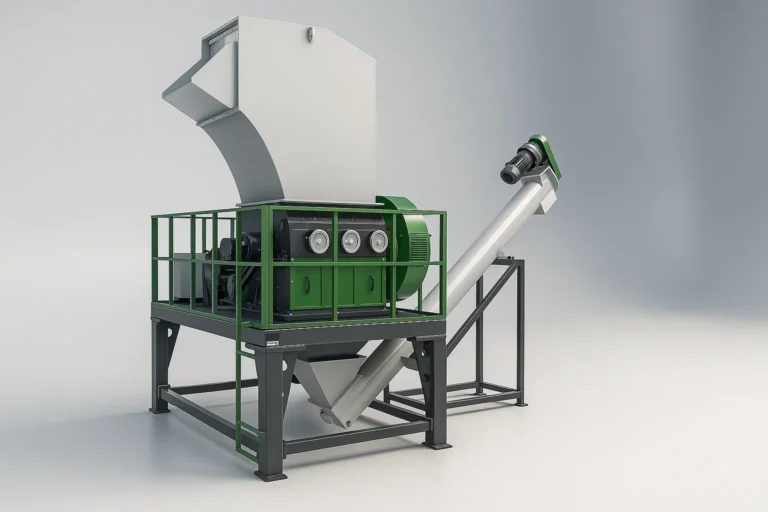
Typical Plastic Crusher Machine Price Ranges (By Capacity)
The capacity you need (kg/h) is usually the biggest price driver because it affects rotor size, motor power, frame strength, and wear parts. The ranges below reflect common industrial configurations for a single crusher (ex-works, without freight/taxes). Your final quotation will vary with material type, screen size, and options.
| Output Capacity (kg/h) | Typical Price Range (USD) | Best Fit |
|---|---|---|
| 300 – 500 | $8,000 – $12,000 | Small/medium plants, sorting centers, trial lines |
| 500 – 800 | $10,000 – $17,000 | Most commercial PP/PE and PET flake production |
| 800 – 1,200 | $15,000 – $24,000 | High-volume lines, central recycling facilities |
Plan additional budget for upstream/downstream handling (for example: infeed conveyor, discharge conveyor, cyclone/air suction, magnetic separation, sound enclosure, or a knife grinder). In many projects, accessories add $3,000–$8,000+ depending on the configuration.
If your crusher operates inside a washing line, a wet plastic granulator (crusher) can reduce dust, improve washing efficiency, and protect downstream equipment.
What Determines Plastic Crusher Cost? (The Factors That Matter in Real Production)
1) Your Material & Feed Condition
- Rigid vs. film: film wraps easily and often needs anti-winding knife geometry and stronger feeding control.
- Sale vs. nettoyage: une contamination élevée en sable/poussière peut accélérer l'usure des lames et peut nécessiter une protection contre l'usure plus forte.
- Densité et épaisseur en vrac: les morceaux épais, les purges d'injection ou les tuyaux nécessitent un couple plus élevé et des rotors plus lourds.
2) Chambre de coupe, rotor et conception de la lame
Deux concasseurs portant le même étiquetage “kg/h” peuvent se comporter très différemment. Le diamètre/la largeur du rotor, le nombre de lames, l'angle de coupe et la conception de la chambre déterminent comment la machine coupe en douceur et comment la taille de sortie reste stable au fil du temps.
- Chambre de coupe plus grande augmente généralement le débit et le prix.
- Géométrie de la lame optimisée réduit les pic de puissance et améliore la qualité des éclats.
- Conception d'accès facile réduit le temps de maintenance et maintient le temps d'utilisation élevé.
3) Matériau de la lame, traitement thermique et stratégie de réserve de lames
L'acier de la lame et le traitement thermique affectent votre coût total plus que le prix de la machine. Les matériaux à usure élevée (généralement de la classe D2/SKD11) durent plus longtemps, gardent mieux l'angle et réduisent le temps d'arrêt - surtout dans les flux abrasifs.
- Demandez ce qui est inclus: un jeu de lames vs. plusieurs jeux, et si le fournisseur fournit un plan de meulage des lames.
- Planifiez les pièces d'usure: lames, écrans, roulements, joints, bandes et vis.
4) Moteur, entraînement et normes électriques
La taille du moteur doit correspondre à votre matériau. Les machines sous-dimensionnées bloquent; les moteurs surdimensionnés gaspillent de l'énergie et de l'argent. Les packages électriques aussi varient (tension/fréquence, composants de marque, protection contre les surcharges, verrous de sécurité), et cela change le prix.
5) Taille du tamis, traitement du rejet et exigences de qualité des éclats
Un tamis plus petit produit un écart d'éclat plus petit, mais il peut réduire le débit et augmenter la chaleur. Si vous prévoyez de laver et de granuler, définissez la taille d'éclat requise à l'avance afin que le fournisseur puisse sélectionner le bon tamis et configuration du rotor.
6) Sécurité, contrôle du bruit et conformité
Les acheteurs professionnels augmentent souvent les packages de sécurité et de contrôle du bruit pour les installations intérieures : protection robuste, interrupteurs de sécurité, points de verrouillage, arrêts d'urgence, et (lorsqu'il est nécessaire) sélection de composants conformes à CE/UL. Ces options augmentent le capex mais réduisent le risque opérationnel.
Sélection du type de concasseur : adaptez la machine à votre application
- Bouteilles en PET / emballages rigides: privilégiez la taille d'éclat stable et une sortie constante pour le lavage et le tri.
- Films et plastiques souples: privilégiez la conception anti-enroulement et une alimentation stable (les films nécessitent souvent un pré-coupage).
- Tuyaux et profilés: prioritize torque, rotor strength, and a chamber design that handles long pieces.
- Mixed bulky waste: consider a shredder + crusher combination for stable feeding and higher overall line uptime.
If you process bulky mixed bales, you may need a primary shredder before granulation. See our double shaft shredder for heavy-duty pre-shredding.
Don’t Miss These “Hidden” Costs When Comparing Quotes
- Conveying & automation: infeed conveyor, metal detection, discharge conveying, and storage buffers.
- Utilities: power cabinet, cable runs, water supply (wet crushing), compressed air (if used), and floor foundation.
- Wear parts plan: included spare knives/screens/bearings and lead times for replacements.
- Commissioning & training: installation guidance, operator training, and safe maintenance procedures.
- Downstream process: washing/drying and pelletizing requirements can change the “best” crusher configuration.
For full-system planning, review our PP/PE recycling washing line et plastic pelletizers to align crushing output with washing and extrusion performance.
Fastest Way to Get an Accurate Quote (RFQ Checklist)
Send these details and you’ll receive a faster, more accurate quotation and a better-matched machine:
- Material type(s): PP/PE/PET/PVC/ABS, film or rigid, and typical thickness.
- Input form: bales, loose, lumps, pipes, purgings; max input size (mm).
- Contamination: sand/metal/labels/moisture; clean vs. post-consumer.
- Target capacity: kg/h (and working hours per day).
- Desired output size: screen (mm) or target flake size.
- Wet or dry crushing: and whether the crusher will sit inside a washing line.
- Site standards: voltage/frequency, space limits, and any safety/compliance requirements.
Buying from Rumtoo: What Professional Buyers Usually Ask For
A crusher is a wear-and-uptime machine. Price matters, but support and parts availability decide your long-term cost per ton. Rumtoo focuses on practical engineering support: we help you match rotor/knife/screen design to your material, and we recommend a wear-parts plan so you maintain stable output and predictable operating costs.
If you’d like a matched recommendation (crusher only or full line), contact us here: Demandez un devis.
Foires aux questions
Q: Why do two crushers with the same “capacity” have very different prices?
A: Suppliers rate capacity under different materials and screens. Rotor size, knife layout, motor/drive quality, and safety package
also change both output stability and cost.
Q: What capacity should I choose if my feedstock changes?
A: Choose based on the most difficult material you expect to run (thick rigid, high contamination, bulky pieces). You can
always run an oversized machine at lower loading; an undersized machine will stall and overheat.
Q: Do I need a shredder or a crusher?
A: Use a shredder for bulky, mixed, or tough-to-feed materials (bales, big lumps). Use a crusher/granulator to produce uniform
flakes for washing and pelletizing. Many plants use both for best line stability.
Q: How long will a plastic crusher last?
A: With correct operation and scheduled maintenance, the machine structure typically runs for many years. Knife life depends on your
material (abrasion/contamination), screen size, and grinding schedule.
Q: What maintenance prevents most downtime?
A: Keep knives sharp, inspect bearings and fasteners, clean the chamber, and monitor motor load/temperature. Stock key wear parts so
you don’t stop production waiting for shipping.
Q: Is wet crushing worth it?
A: Wet crushing often reduces dust and improves washing performance for post-consumer plastics. It also requires water management and
corrosion-aware design. If your crusher sits inside a wash line, wet granulation is commonly the better choice.
Q: What should I check before placing an order?
A: Confirm the material and screen size used for capacity rating, review the knife steel/heat-treatment and spare parts list, and
verify safety guarding and electrical standards for your site.
Conclusion
The best plastic crusher purchase balances price with throughput stability, wear cost, safety, and service. When you compare quotes, focus on your feedstock, knife/rotor design, and the total system (feeding, washing, and pelletizing)—not just the base machine.
Share your material photos/videos and target kg/h, and our engineers will recommend a configuration and a clear quotation: Talk to Rumtoo.
Get a crusher recommendation that matches your feedstock
Send your material type, max input size, contamination level, target kg/h, and desired flake size. We’ll reply with a clear configuration suggestion and quotation.
